
Prime Minister Narendra Modi paid tribute to the victims of the Jallianwala Bagh massacre, emphasising their sacrifice and indomitable spirit.

Civil society members and lawyers in Lahore, Pakistan, commemorated the 107th anniversary of the Jallianwala Bagh massacre, paying tribute to the victims of the 1919 tragedy.
The budget session of the Delhi Assembly concluded with over 15 hours of legislative business. Speaker Vijender Gupta voiced concerns over the opposition's conduct during the session.
Civil society members and lawyers in Lahore paid tribute to the victims of the 1919 Jallianwala Bagh massacre at an event held at the Lahore High Court.
Uttar Pradesh Chief Minister Yogi Adityanath and other leaders paid tribute to the victims of the Jallianwala Bagh massacre on its anniversary, honouring their sacrifice and courage in the Indian freedom struggle.

Rajaji, an ardent follower of Gandhi, was a freedom fighter, scholar, jurist, statesman and the first recipient of the Bharat Ratna along with S Radhakrishnan and C V Raman.
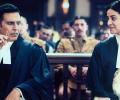
If you disregard history and are ready to watch Kesari 2 purely as an entertainer, you are definitely going to enjoy it, feels Utkarsh Mishra.

One hundred years ago, a group of 10 revolutionaries carried out an operation that shook the British Empire. Utkarsh Mishra revisits the 'Kakori Conspiracy Case', a turning point in the armed struggle for independence.
Ram Madhvani's series is all over the place and also boring to watch, complains Deepa Gahlot.
The move prompted a strong reaction from the Congress, with its state unit chief Ajay Kumar Lallu equating it with the 1919 Rowlatt Act or Black Act and saying that the party will explore legal options to challenge it.

It took Udham Singh 21 years to avenge the massacre of Jallianwala Bagh. And 34 years for his remains to return to India after execution in a British prison.

There are laws that are as out of time and place today as the Rowlatt Act was a century ago, explains Aakar Patel.

The grilling of Brigadier-General Dyer by Akshay Kumar's Sir C Sankaran Nair, as shown in Kesari 2, is purely an imaginary sequence, proves Utkarsh Mishra.
'Till we are able to understand this reality of what is happening to our fellow citizens today in 2018, it would be hypocrisy to continue to teach in our textbooks about the great atrocity of 1919,' argues Aakar Patel.

Over 1,000 people were killed and hundreds wounded on April 13, 1919 when British troops fired indiscriminately on an unarmed gathering of thousands who had assembled in Jallianwala Bagh amid nationwide protests against the Rowlatt Act which had extended wartime repressive measures.

Politicians, historians have criticised the work terming it an "insult towards the martyrs".

'A lot of what you see on screen, particularly the night of the massacre, is pretty close to what really happened as it is based on survivor stories.'

Some major events that occurred from 1885, when the Indian National Congress was formed, till August 15, 1947, when India achieved Independence.
'This is against the Constitution and we will oppose it tooth and nail.'
'The BJP's all-India plans can be expected to become clearer around 2022-2023, particularly if -- as some anticipate -- the senior Congress leadership cracks, broadly as between the Nehru-Gandhi loyalists and those who may be termed 'pro-changers',' observes Arun Bhatnagar, a retired IAS officer.

Even with more power against the individual than any other modern democratic nation, the Indian government seeks more. Such laws do not exist elsewhere in the civilised world, observes Aakar Patel.
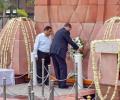
Modi's absence from an event to mark the centenary of a definitive moment in Indian history puzzles Utkarsh Mishra.

'The creation of Pakistan was integral to Britain's grand strategy.' 'If they were to ever leave India, Britain's military planners had made it clear that they needed to retain a foothold in the NWFP and Baluchistan because that would provide the means to retain control of Iran, Iraq, Kuwait, the UAE, Bahrain and Qatar.'

'Over one million people served in various battlefronts during World War I. And yet, even today, we know so very little about them.' 'It is absolutely essential to acknowledge this part of India's colonial history,' Santanu Das tells Vaihayasi Pande Daniel/Rediff.com
